Sunday, December 8, 2013

#Homebrewing: Dunkelweizenguy's Outcome, Witty Hard Cider, and Stout Study v.03

A Hoppy Christmas Ale

"Dunkelweizenguy" fermented fast and furious, overflowing a bit (requiring we refill the airlock with sanitizing vodka), and then took about 2 weeks in a colder spot (near a window) to start cleaning and mellowing.  As of last night, it tastes like I ended up making 5 gallons of bootleg Sierra Nevada "Celebration Ale", which is nothing to sneeze at, unless your allergic to hops.

The aroma and taste are very hoppy, but not cheesy or perverse like tube socks in soup or a salad of rotting vegetables, and not overpowering as you'd expect in a thin light beer with nothing more to say for itself as hops invade taste buds, because the extra malt of this Dunkelweizen inspired recipe abides.

This batch turned out great-- the goal was a hoppy Christmas, and thanks to Brewcraft and Hop Union my hop list ended up making a bitter blanket of piny flavors and aromas. The list included: Palisade (7.8% Alpha), Chinook (11.7% Alpha), Citra, and Nugget  (12.2% Alpha).

Racking will commence in one hour ago.... mid afternoon and evenings are better for bottling, since the 6 stages of obligatory sampling are involved.


 Witty Hard Cider
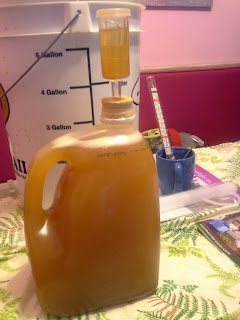
 Meanwhile, after over malting an experimental batch of cider with wheat in November, I did another gallon 3 weeks ago, with 1/4 the malted wheat, and it's turned out way more drinkable, delectable, and delightful, if not teh "amazing and delicious".   The experimental batch was absurd, with big, bold, and filled with off flavors, like a Mary Shelley's Cider house Rules for making Hoegaarden.  Exactly-- makes no sense.

This batch, by contrast, with 1/4 the malted wheat, turned out pleasing.  and it just means more Christmas cheer on top of the bucket of Dunkelweizenguy, the outcome of this odd, if obvious combination that I've not had anywhere before.  It's got flavor elements of banana and apple, and I'm thinking by adding Cinnamon and some clove, we'll have something worth writing homeys about in by New Years.


Stout Study v.03

Egged on by the Dunkelweizenguy batch, and the mice eating at my inventory, I went back to the drawing board, using bits and pieces of grains and extracts I had handy, and went reaching for an offbeat stout for my long winter's 2014 nights.

 
The 80 minute boil included an ingredient list of 3.9 pounds of Mouton's Export Stout, 6 oz. of Northern Brewer Malted Wheat extract.

It also included grains that I mashed for a half hour below 150 degrees (for the most part), with a few short pauses where the temperature dropped below 135, hoping to keep the flavors of the grains more dry than sweet, which generally results from mashing, laughtering and sparging at higher temperatures.

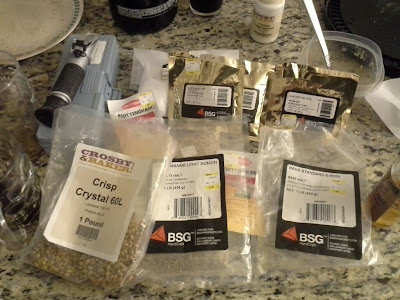
The grains were a strange mix in a bag--  one lb. of Briess' Crystal 10, one lb. of roasted American 6 row (that promises to taste like sourdough according to Briess' lable), one lb. of Briess' "Carawheat", 1/2 lb. of dry malt extract powder, and 3 oz. of Wisconsin Wildflower honey.   Note to the future: impatient and tired of the rolling pin thing, I ground the up in a food processor, which may have been too fine to capture the desired flavors, but time will tell.

The Brix for the 6 gallon pale came in at just under 4 to start, which meant a predicted 2.5% ABV after the mash, but buy adding honey, the Brix raised to nearly 7, which suggests a ABV of 3 to 3.5% with any luck.  I am aiming for a stout without too much ethanol, like traditional stout, something that doesn't put a red hot bun on your nose after one beer.

The hops for this stout were small doses of my favorites, strong, piny and spicy:  one oz. of Centennial and Chinook.  I'm hoping Small doses of strong aromatic hops will add a nice touch to an offbeat stout.

I'm also dry hopping this stout so the aroma battles it out with the roasted flavor. 

It's the second time I've been unable to locate my Peat Moss for the boil.  I was kind of pissed off when I found it this morning, but it's more vital for light, clear beers, like the Wit I'm fixing to brew next with what grains and what extract I had left.


Public Service Announcement-- Beer reduces risks of Kidney Stones!?!


Dunkelweizenguy: A Hopped, Dark Wheat Christmas, and A Centennial Weizenguy

With Christmas a few weeks out, and based on inventory, I went for two batches of something a little unconventional, like Abby Hoffman at a prayer breakfast.

I started with several grains and malt mixtures, as well as several hop options, including little bags of Nugget, Hallertau, Szaas, Palicade, Citra, Centennial and Chanook, and went looking for a recipes to fit the bill.

For the first batch, the closest thing I could find in the BeerSmith software database was Dunkelweizen, but I decided to make it with way more hops than any recipe I could find.  So that's right-- I'm going straight for that "muddy blend of hops and malt", as one home brewer put it.

  According to BeerSmith software, Dunkelweizen was a popular beer style in Europe up to the 1950s, when it began to be associated with older beer drinkers, who emphasized it's health benefits to the deaf ears of the youth.  And so the market disfavored it, and commercial brewers stopped making it.

Starting with 2 lbs of caramel wheat grain, 5 lbs of Munich liquid malt, 2lbs of Northern Brewing's Wheat liquid malt, 1lb of dry malt extract and a half lb of honey, and half pound of dextrose, I heated grains in the 149 degree range for 30 minutes in the hopes of getting liquid from lautering the roasted wheat that's neither overly dry form lower temperatures, or sweet from temperatures in the 155 range.

After lautering, I ramped up the heat to boiling for 70 minutes, adding greater amounts of bittering hops (Nugget, Chinook, Palicade and Hallertau) every 10 minutes or so until the last 15 minutes, when I added aromatic hops (Citra and Palicade).

I ended the boil when the very bready aroma was greatly reduced, and at that point the gravity came to 14 Brix by spectrometer, or over .50 on the hydrometer.

The morning after I added Nottingham yeast at 85 degrees, which took a day to go ass wild, and it kept bubbling through the airlock for 4 days hence.


This second batch was brewed at a friend's house, was a similar radical departure from strict style guidelines, well outside the suggested hop additions and the collective words of wisdom on the home brewing message boards.

We chose a variety of malts, including Crystal 60L, Light Munich and a Rahr six row for base grains, as well as Northern Brewer's liquid Wheat malt extract.  The Rahr is used often in American wheat beers for it's high gravity, high protein qualities.  In addition, we used a pound of dry malt extract and corn sugar to give it an even higher ABV.   We were drinking Bell's Stout, as you can see here, which did not aid our detail orientation at a certain point, along with the protracted chit chatting.

Then we chose just two hops, the noble Saaz and Kenny and Zimmerman's epic and popular 90's variety, Centennial to give the Wheat beer mad, citrus flavor, however unconventional.

The Wheat beer promises a lighter color, a more diverse malt character, with less hop variety to "muddy" the mixture as grouches have grumbled.  But Centennial is no slouch in the bittering or aroma department, which makes it very popular at the IPA arms race going on among American craft brewers.


The hydrometer read well over 50 at the start, as the spectrometer topped out at 17 brix, which should bring this puppy juice in at and astonishing 9.50% ABV.   That testimony to drinking a little less beer while committing to brewing, at least the part where you keep adding malts.

We may have had a bit of a heavy hand in that department, but it was all in good fun.

We used 6 pounds of grain here, in contrast to the Dunkelweizenguy I made first.   Maybe this is just the "Weizenguy" to my "Dunkelweizenguy".

Stay tuned for our result around Christmas week.


Wednesday, November 27, 2013

Ommegang's "Wild at Heart" (but you knew that), and the Actual Truth About Newburgh Brewing's "Bitter English".

Okay, to summarize the last few weeks, since my visit to Ommegang, where I discovered many interesting data points about their beers (for example, all Ommegang beer starts off life as a Pils, made with two row, grain from the fine folks at http://Briess.com/, which supplies breweries far and wide).

I managed to take home one of Ommegang's more unique creations, "Wild at Heart," which features a howling wolf lording over a tiny squirrel on the label, but upon tasting kind of reminds me more of the David Lynch movie from the early 90's, or, oddly enough, maybe just the kind of whiskey drinking anyone could see (and join) Nicholas Cage doing at Nell's on 14th Street around that time.   This is a thin, boozy flavored ale.

I'm not going to say medicinal, jarring or that in any way were their off flavors, but it was thin, tart, somewhat fruity.  And I'd say this thoroughly "ethanolicious" or "ethanolacious" (depending on how you feel about the taste of a beer with a highly above average, ABV flavor, which carries up through one's nose to alert one's brain to the fact you need to "go slow").   It's an ale, made with wild yeast in primary fermentation, which is later hopped up with just enough Motueka and Topaz hops to remind you that it's beer, and not hard cider,  or say, toilet wine, depending where life's lead you.

Delicious?  Amazing?  Certainly, if you enjoy high powered, thin Belgian style beer.  If you enjoy thin, light, American commercial beer under say, 100 calories, so you can fit into your skinny jeans, you may be shocked and awed by this "audacious" beer (as the commercial description puts it) that this audacious brewery has harvested from the forests of Cooperstown, NY.  This is a good time to note my strong sentiment that Ommegang does have some of the best advertising copy of all the beer label I've read.

Here's the Beijing Consensus on Ommegang's "Wild at Heart":


We're talking an "83" from the unwashed masses at Beer Advocate, and 3.5 out of 5 from Joe T's beer syndicate at Ratebeer.com.  I think Wild at Heart is probably well better than all that noise, but who are any of us to argue with our crowed sourced reality, right?

And that opens a very interesting can of worms about accounting for the taste of beer as much as it does for accounting for tastes in wine.

Reasonable people may disagree on matters of taste, but I say the kind of feedback these beer rating sites provide are a damn sight better than the kind of subjective, cooked up reviews people turn to from Robert Parker's pen in "the bible of wine... blah blah blah", as the CBS Sunday Morning put it last week (citing a review of a wine in The Wine Spectator).

This is just a disruptive photo of Newburgh Brewery's epic, outstanding and extraordinary "Bitter English" that I recently drank, enjoyed and shot, along with the outside wall and their big inside beer hall (for detail, now see here, old boy: http://www.newburghbrewing.com/beers/bitter-english/)


And here's a Guardian story which makes brief mention of how "Orley Ashenfelter, a Princeton economist, invented a simple mathematical formula based on weather data to predict the price of vintages, which mimicked the predictions of Parker’s system," even if there's probably more to the story than that, mate.  

http://www.theguardian.com/lifeandstyle/2013/jun/23/wine-tasting-junk-science-analysis

As I heard tell, it's more like Ashenfelter's work mocked more than "mimicked" Parker's bible, after Ashenfelter basically started a very small journal concerning wine economics (and it's linkage to agriculture) which quietly annd quickly change the entire industry (valuations of wine) inside just 10 years (as all commercial bidders came to subscribe and adopted his algorithm the way the Oakland A's, Boston's Sox and Moneyball changed Baseball scouting).   

Obviously what crowds think, feel and believe matters, making it a fools errand to try to dictate taste in the face of 50,000 Swedes.  But one can describe, and show, like this photo of Newburgh Brewery, which has many outstanding, fresh beer choices on the Western banks of New York's Mid Hudson Valley, just 1 1/2 hours from NYC.  The skinny is that the brewer has many years of experience a Brooklyn Brewery, where he clearly paid attention. 

This is just one of Peekskill Brewery's tasty thin, toasty Dark, Dry ales, which you'll find down river and across from Newburgh on the Hudson Harlem line about 1 hour North of NYC.  The brewer here also knows a thing or two about a thing or two in and of the beverage arts.

Orley Ashenfelter's advise on accounting for the taste of wine:
http://www.liquidasset.com/tasting.html


Wednesday, November 6, 2013

Farewell Belgian Pale Ale, We Hardly Knew Ye Downstate from Ommegang

It's Ommegang is probably the first name in New York craft beer, and well worth the long ride to get to Cooperstown, NY.

I had one of the last keds of Ommegang Belgian Pale Ale, which was both malty and all hopped up with Centennial, as I recall. And it was just about perfectly balanced to the malt-- no, I can't lie-- it was perfect. 

It was grand, as you can see in the photo below. In fact, I nearly didn't get to photographic because I was gulping it down like a kid slurping Pepsi at a Star Wars Film Festival.  Look at that color and lacing on that glass, you lovers of lacing.

Sadly, we were told on touring the brewing and bottle areas that this beer is being retired for a new dry hopped style.  So stay tuned on that front.

The food was also grand, if not all that "Amazing & Delicious" you're probably hearing about:  ham and cheese sandwich, lentil soup, frits and Belgian chocolate with hot pepper on top.  Really very good brew pub food too, in a great setting too.  The grounds are vast, and do double duty as a concert area in Summer.

Sure, the dudes were a little distracted and forgot a few things the old folks ordered (hot chocolate) because they were busy upselling us Lambics and 3 Philosophers.  But what we got, hit the spot to be sure.


Ommegang does 40,000 barrels per year, and it all starts right here, with two row, Wisconsin malted Pils barely, after which they add their roasty adjuncts, well placed hops and Belgian fairy dust.  Many of their beers are bottle conditioned.  So it was interesting to see their yeast harvesting area too, and even the 3 pot Sabco tucked away in the corner that they use to test new flavors.

I don't feel like I'm going out on a limb here, but I'm pretty sure the beer made by Brouwerij Duvel Moortgat, NV's is the best beer on Earth.  So it's nice that Ommegang in New York has them as a parent company.  It also means American craft brewers have to elevate their game.  It's not as if you just have to make high AVB beers that tastes better than giant beer-soda makers A-B Inbev and SAB MillerCoors anymore. That have to deal with the Belgians, and these Godzilla Ales they are putting out from the mountains not far from Cooperstown, NY.   

 What's more, the employees told us that they routinely meet with the family that has owned Duvel since the 1800's (and that they "are really cool"), so there seems to be no danger that this brand will lose its luster the way the thin, dull, bland "king of beers" did, as was recounted by William Knoedelseder's excellent book about the shocking history and pronounced fall of Budweiser.  Nobody is asleep at the switches here.


Here's some detail about the BPA:
http://www.ommegang.com/#!beer_bpa


Tuesday, October 29, 2013

Ethanol... taking Stock, and maybe shorting it.

Blogging about beverages from a consumer's standpoint is a lot of fun, but there's another side to all the lids on all these bottles, kegs, and mason jars we tap.

It's instructive to look at the Ethanol from Wall Street point of view, as in where asset managers put "their" dollars to work in the beverage business. And by "their", I mean your pension, annuity, and savings. Just as our government is representational, in most cases (day traders and "home gamers" aside) so too is the allocation of institutional resources to enterprise. That includes beverage businesses. 


One storied proxy for Wall Street's investments in ethanol is The Vice Fund, which began in 2002.  Ethanol is one of four legs of the stool they constructed to tap reliable returns from four basic business sectors that are considered counter recessionary (and depressionary if it comes to that), because like sin and crime, these pass times will always be with human kind, come hell or high water.  And The Vice Fund has delivered superior returns since inception, despite the epic slide of 2008. 

They invest in Alcohol, Gaming, Weapons, and Tobacco.  Their rational of their screen is as follows:
 
» Potential demand regardless of economic conditions
» Global marketplace not limited to the U.S.
» Potentially high profit margins
» Natural barriers to new competition
» Ability to generate excess cash flow
» Ability to pay and increase dividends

And the companies they liked best in 2012 for their predictable cash flow and dividends they share with share holders were, predictably:

Anheuser-Busch InBev NV - (ADR)
Beam, Inc
Diageo, PLC (ADR)
Molsons Coors Brewing 

As investment risks go, political headline risk is to which one should remain on watch.  It is not unforeseeable that companies who (yes, they are people now) really get hot and heavy into politics for competitive advantages are likely to be taken to task by consumer of one or another stripe at some point for their self dealing at the expense of the common wheel. And so if one takes stock in ethanol companies, it may both pay, and also save a good loss to stay tuned to that sort of thing (boycotts, resentments, burning CEO or Lawyer-lobbyist effigies, etc).  Here is a link for other interesting information about Diageo, which like Altria-SAB-Miller-Coors, has links to A.L.E.C. (see, http://www.alecexposed.org/wiki/ALEC_Exposed) , the powerful lobbying organization that is changing the political landscape of America on a local level, quietly and without much debate, one state at a time:  http://www.sourcewatch.org/index.php?title=Diageo

Diageo net's about $2.4 billion per year, but laying down with despised dogs to protect its competitive advantages could amount to the kind of fleas that can put your portfolio to sleep.

Nonetheless, The Vice Fund is a good example of an investment company that screens investments on any number of metrics and related issues to find the best of the bunch in these "vice" industries, of which ethanol a probs. charter member. As active trading company, they sort of represent that they will pull out of an investment that threatens to put your money to sleep in the aforementioned, forseeible manner.  You'll find info about The Vice Fund here:

http://www.usamutuals.com/vicefund/phil.aspx
Information Sheet:
http://www.usamutuals.com/vicefund/docs/VICEXcomplete.pdf


Friday, October 11, 2013

WARNING: New Weapons of Mass Consumption Emerging from Nation's Orchards!

Warning!  

This simple array of common household staples is striking fear into the hearts of beverage company executives and their vast networks of distributors, including bar tenders from Washington to New Hampshire because with these items and a few simple steps,  #homebrew fanatics are fermenting their own varieties of ethanol laced Hard Ciders, Perries and even other kinds of high gravity ciders made with Cherries for consumption in a wide variety of settings, from Seasonal, so called, "Halloween" parties, where these extremists actually watch as their own children dunk for apples, as far fetching radicals sip their own #ciders.

They also commonly go about "tailgating" at so called, "Tailgate" gatherings in parking lots where like minded #cider zealots BBQ meats in sweet and sour sauces before moving into a crowded stadiums to cheer on sports teams with a reckless abandon not seen since the Roman bread and circus.  What's more: some of these sauces may even be made with #homebrew hard ciders!

Beverage Industry insiders, and the Tea Party Leaders in Congress, to whom they contribute in Washington, DC to further their interests are none too thrilled with these recent developments, as these so called #Homebrew cider fanatics aim to put a serious dent in discounted future cash flows of beverage companies that have been organized to capture and maximize profit from a nation's thirst. 

Experts say, it all starts with this (right photo insert)--  Apple Cider, in it's raw state, pressed from the fruits of all but poisonous trees in states on farms where farmers encourage unsuspecting patrons to pick their own apples with signs that read, or "U-pick" or "Pick your own".  Experts also say you can make a difference.

Says one anonymous #cidersafe expert, who shall remain nameless, told reporters: "There is a lot you can do to help beverage companies sustain the monopolistic hold on beverage consumption of consumers that allows them to pay me so much, just by reporting what you see to the twitter hashtag: #Cidersafety, as well as other #cider hashtags you may run across... just remember to point your smart phone camera, shoot, taste, then post to #cidersafety".

So stay safe, and if you see something, drink some of this emerging #hardcider after you take a picture to be sure it's genuine #Homebrew!  


Thursday, October 10, 2013

What's that Word When You're Busting Loose?

That's right old dogs, it's "Juice, Juice", and if you can recall that song, you probably should be juicing every now and again, if not seriously considering salads, in the words of the late Tony Soprano. 

And after Juice, the word is Nutri-Bullet.  That's right, the late night informercial sensation works like a charm. This is not Slap Chop deal.  This blender is outstanding for making ethanol free, extraordinary flavored beverages with a absurd plethora of nutritional benefits. 

But since I'm not your mom, or Dr. Oz, I won't list them.  Let's just say "a nod's as good as a wink to a blind bat, ay" (see, "Fat, Sick and Nearly Dead", the movie, if any of this is lost on you, and your still reading this.

At any rate, here's one way to start a day with a green monster-- lemon juice, fresh, ginger, Jalapeno chili, spinach, kale, parsely, Cherry cider and a little wheat grass power from the Trader Joe's.  


 Stage 2.  The mix.  Noisy but fast-- count to 30.


Stage 3.  Nice opaque green color, frothy head. 


Fresh spinach and ginger aroma dominate, with major cherry notes, as kale sort of recedes into the blend.  Taste, what you smell is what you get, even after 2/3 dilution with water.

Think of your favorite beer, wine or hard cider, then times those qualities by about 100 and you've got a reasonable estimate for rating juice like this, and I'm not trying to sell juicers, vitamins or supplements. There you have it... well, actually farmers at farmer's markets are who have it, in the event you want to give you liver a sorely needed break.